
This is lesson number one here as a favor to those starting out in Metrology. One of the faster ways to accidentally lose the respect of your customer, co-workers and peers in this industry is to not understand how to communicate measurements properly. Any time somebody says “zero point zero zero one inch” in the field, you can see people’s heads raise and eyes dart. That person just outed themselves as someone who doesn’t know what he’s talking about, and may not know what he’s doing then either. Why is this?
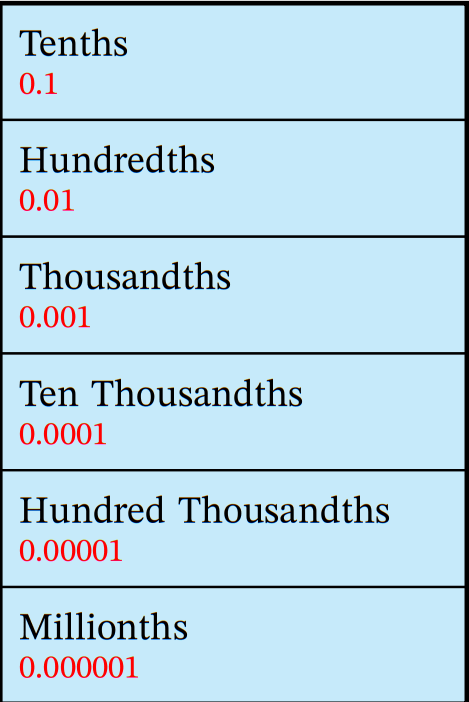
As we know from math class, 0.1 is a tenth of an inch. You’ll hear machinist boasting of a tenths accuracy. They can’t possibly mean 0.1 inch, can they? That’s too wide a tolerance…
The answer is simple. All machinists serve one god, the thou or thousandth of an inch. THIS is what you call 0.001″ if you want to be understood and respected. As the thousandth is god, everything they’re speaking is in relation to that. Therefore, a tenth to a machinist is a tenth of a thou, or 0.0001″ in value.
So what about tenths and hundredths of an inch? They are 100 and 10 thousandths of an inch respectively. Like I said, EVERYTHING relates to the thousandth. When you pick up the half inch gage block, you’re picking up the 500 thousandths gage block to a machinist.
Machinists also seem to have decided that hundred thousandths is no good at all when speaking, and they combine the fifth and sixth decimal places. So, instead of hundred thousandths, they’re ten millionths. Therefore, 0.000047 would be stated forty seven millionths for ease.
Here are some examples that should help you understand how to communicate:
0.00196 might be referred to as one thou, nine tenths, sixty millionths. A machinist would never say “point zero zero one nine six,” although in this case it almost seems easier.
0.129 would be stated as a hundred twenty nine thousandths or thous.
0.2053 might be stated three tenths two hundred five thousandths, or two hundred five thousandths and three tenths.
0.00083 might be stated eight tenths, thirty millionths, but would acceptably be called eight hundred thirty millionths as well.
We all need to universally understand each other and be able to communicate sizes, tolerances, and deviations in a clear and concise manner. Not understanding that everything relates to the thousandth in machining is a big red flag that you don’t know what you’re talking about. A machinist will never say “point zero…” and emphasize the decimal. It’s always presumed we’re speaking in thousandths and working well past the decimal.
As a side note, there are other theories as to how the tenths jargon came about. One is that old machinists were actually saying ten thousandths as tensths, and eventually the S slipped out and they say tenths as slang for tensths, with just a universal understanding.
It’s possible, but I find it simpler to think of the thou as god, and the tenth as a one tenth of god. There may be regional or industry specific differences as well. I’d love to hear about some of those in the comments section below.


Leave a Reply